
Choosing a Mining Pool in 2026: Six Things to Verify
Six numbers decide whether two pools are comparable, and most of them never appear in a headline rate. At 800 TH/s the difference between a listed 4% and a listed 2% on the block-reward component is about $19.39 a month, while a single day of missed uptime costs $32.31 of gross income — so the order in which you check things matters more than the marketing does.

Key takeaways
- Verify the fee base first: a listed 4% against the PPS-settled block reward is not the same deduction as a listed 2% across both components.
- Settlement cadence is the second check — hourly at current difficulty under PPS+, or after 6 confirmations across the last 5 difficulty rounds under PPLNS.
- Pool size and luck visibility belong on the list because they change what you can measure, not just how often blocks arrive.
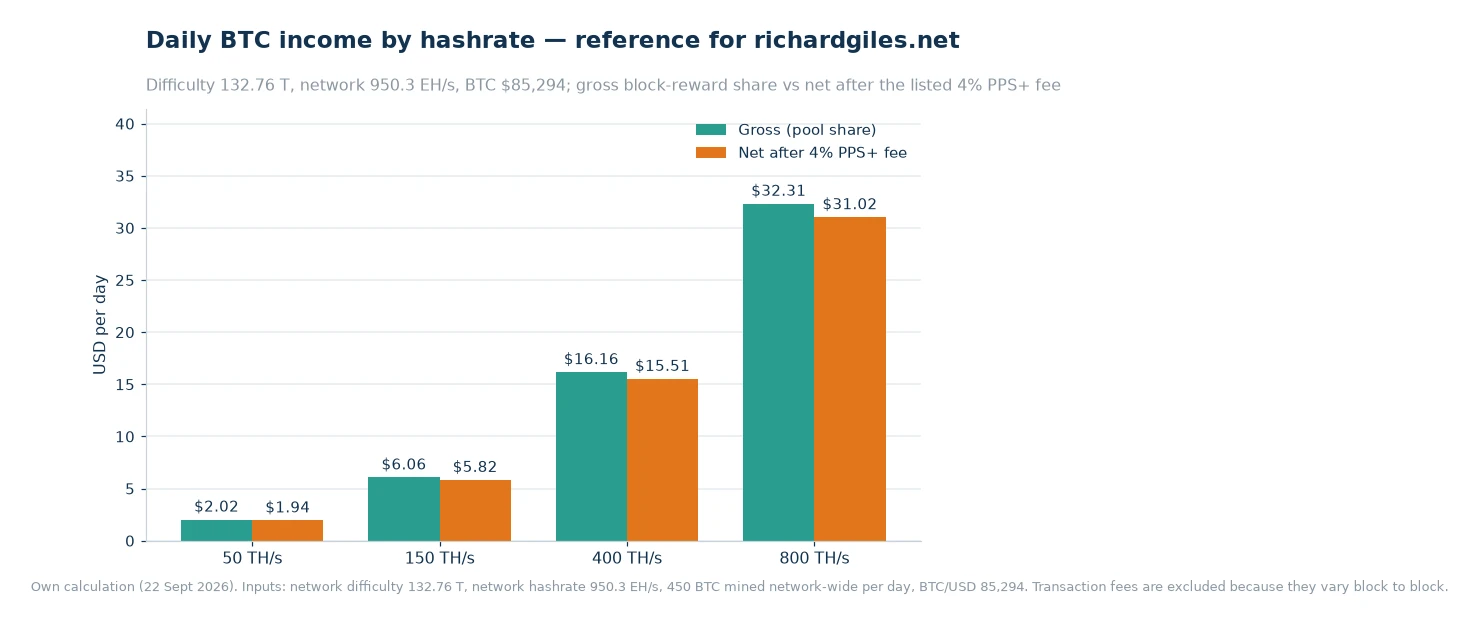
- At 800 TH/s, gross income is $32.31 a day; the listed 4% on the block-reward component is about $1.29 a day on that output.
One: the fee base, before the fee rate
Every fee comparison starts with a question the percentage cannot answer: what is it charged against? Under PPS+, the block-reward component is settled at a listed 4% and the transaction-fee component follows PPLNS logic at a listed 2%. Under PPLNS, both components are pooled at a listed 2% and distributed after 6 confirmations across the last 5 difficulty rounds.
Those are different products with different exposure, and a rate quoted against total income means little until you know which component it touches. The practical test is to take your own output at current difficulty, apply the rate to the component it names, and see whether the monthly number looks the way the brochure implies. At 1 PH/s, the difference between the listed 4% and a listed 2% on the block-reward component is about $24.23 across 30 days — smaller than most operators assume, and large enough to matter at scale.
Two: settlement cadence and confirmation rules
PPS+ pays hourly at current difficulty, which means the balance moves in small frequent credits and the pool carries block-timing variance. PPLNS pays after 6 confirmations, so credits appear after a block is buried rather than the moment it is found, and each one is scaled by the share you contributed across the last 5 difficulty rounds.
Cadence is a cash-flow property, not a quality signal. Hourly settlement suits an operation that pays power monthly and wants income that matches; block-by-block settlement suits an operator with reserves who prefers a lower listed fee and accepts uneven arrivals. What matters is that the published wording matches what you are modelling, because a two-day lag between finding a block and being credited is entirely normal and looks like a fault to anyone who expected hourly.
Three: pool size and what it lets you measure
A pool's own hashrate decides how often it finds blocks and how quickly its luck averages out. That matters directly under PPLNS, where income follows the pool's block arrivals, and indirectly under PPS+, where it does not change your income but does change how much of the pool's operation you can see.
Visibility is the underrated part. A pool that publishes its hashrate, its share of the network and its recent block history gives you the inputs to check your own credited share against reality. Confirm what the pool credited over a period, compare it with the hashrate you actually delivered, and the difference is either explained by the published luck or it is a fault worth raising. Without those figures, you are trusting a number you cannot reproduce.
| Check | The figure that answers it | Why it changes the decision |
|---|---|---|
| Fee base and components | Listed 4% on the PPS-settled block reward, listed 2% on transaction fees | About $24.23 a month between a 4% and a 2% block-reward rate at 1 PH/s |
| Settlement cadence | Hourly at current difficulty, or after 6 confirmations over the last 5 difficulty rounds | Sets whether income arrives as a steady stream or in clusters |
| Pool size and published hashrate | Share of the network and recent block history | Decides how fast pool luck averages out and how much you can verify |
| Withdrawal cost | Zero-fee mining payouts | Changes how often withdrawing to a wallet makes sense |
| Coin coverage | More than 20 coins, including merged mining on LTC with DOGE and networks such as KAS | Decides whether one account can carry the whole fleet |
| Uptime and monitoring | Real-time hashrate alerts, multi-account view, low-latency nodes | A missed fault at 800 TH/s costs $32.31 a day of gross income |
Four and five: withdrawal cost and coin coverage
Withdrawal cost is easy to overlook because it is not always described as a fee. Where mining payouts carry no fee, moving a settled balance is a scheduling decision rather than a cost line, and it becomes reasonable to withdraw more often for record-keeping rather than to batch redemptions to minimise charges. Where a fee exists, the effective rate on a small balance can exceed the pool's own listed rate, which is a comparison most rate tables never show.
Coin coverage matters for a different reason: it decides whether a fleet has one account or several. A pool supporting more than 20 coins — including merged mining on LTC with DOGE and separate networks such as KAS — lets a multi-algorithm operation keep payouts, conversions and records in one place instead of reconciling exports from three dashboards at month end. Merged-mining output should still be valued separately, because the two assets move independently.
Worked example: pricing six checks at 800 TH/s
Line one. At 800 TH/s the per-terahash rate of 0.0000004735 BTC gives 0.0003788 BTC a day, which is $32.31 at a BTC price of $85,294.
Line two. Across 30 days that is 0.011364 BTC, or $969.30 gross before any listed fee.
Line three. Net of the listed 4% on the PPS-settled block reward, the figure is about $930.60 — roughly $38.77 a month, or $1.29 a day, on that component.
Line four. A pool charging a listed 2% on the same component would leave about $950.00, so the gap between the two rates is roughly $19.39 a month at this hashrate — the number that makes a rate difference concrete.
Line five. Against that, one day offline costs the entire $32.31. Uptime beats a rate advantage at almost any realistic spread, which is why monitoring belongs on a list that starts with fees.
Six: operate it before you compare the rest
The last check is operational and the least glamorous. A pool is only as good as the latency between your machines and its nodes, the honesty of its hashrate reporting and the speed at which you learn that something stopped. A 150 TH/s worker that dies quietly on a Friday and is noticed on Monday has cost about $12.12 of gross income, and no fee schedule absorbs that.
Practical checks take an afternoon: point one worker at the candidate pool and compare realised hashrate with nameplate for 72 hours, set up alerts so a drop is visible rather than discovered, and confirm the credited share against the pool's own published figures. The ViaBTC Mining Guide documents the connection settings and payout options per coin, which is the fastest way to run the test without guessing at the configuration. The Profit Calculator then tells you whether the machines you own still clear power at the pool's published rates.
Where an operation is large enough to be worth hosting discussions rather than self-hosting, the Mining Companies directory is the place to compare providers on published terms instead of word of mouth — a different decision, but one that interacts with everything above it.
Frequently asked questions
Which check should come first?
The fee base. A rate without the component it applies to cannot be compared with anything, and the gap between the listed 4% and a listed 2% on the block-reward component is about $24.23 a month at 1 PH/s.
Is hourly settlement better than per-block settlement?
Neither is better in total. Hourly settlement at current difficulty gives steadier cash flow under a listed 4% on that component; PPLNS with a listed 2% on both components gives lower fees and uneven arrivals after 6 confirmations.
How many coins should a pool support?
Enough that one account can carry the fleet. Coverage of more than 20 coins, including merged mining on LTC with DOGE and separate networks such as KAS, avoids reconciling several dashboards at month end.
Six checks, then a decision
Run them in the order above and the comparison takes an afternoon: the fee base, the cadence, the pool's published size, the withdrawal terms, the coin coverage and the operational reality of pointing a worker at it. Anything still unclear after those six is usually a question worth asking the pool directly rather than assuming. Difficulty moves every 14 days, so the arithmetic behind the decision should be re-run at least as often as the network changes it.
Data and sources: ViaBTC listed fee schedule[1]. Difficulty (132.76 T), implied network hashrate (950.3 EH/s), 450 BTC issued network-wide per day and the BTC price of $85,294 were read from public chain data and market feeds on 22 September 2026; read 22 Sept 2026. Figures are arithmetic on those inputs, exclude transaction fees because they vary block by block, and are not a promise of earnings.