
Three Exclusivity Clauses Online Fragrance Brands Misread
Most exclusivity problems in fragrance sourcing come from one sentence that means something different to each side of the table. The brand reads it as the scent is mine; the supplier reads it as we will not sell this exact formula to someone else. The gap between those readings is where reorder problems appear. Three clauses cause most of it, and each one can be fixed with a single clarifying line.
Key takeaways
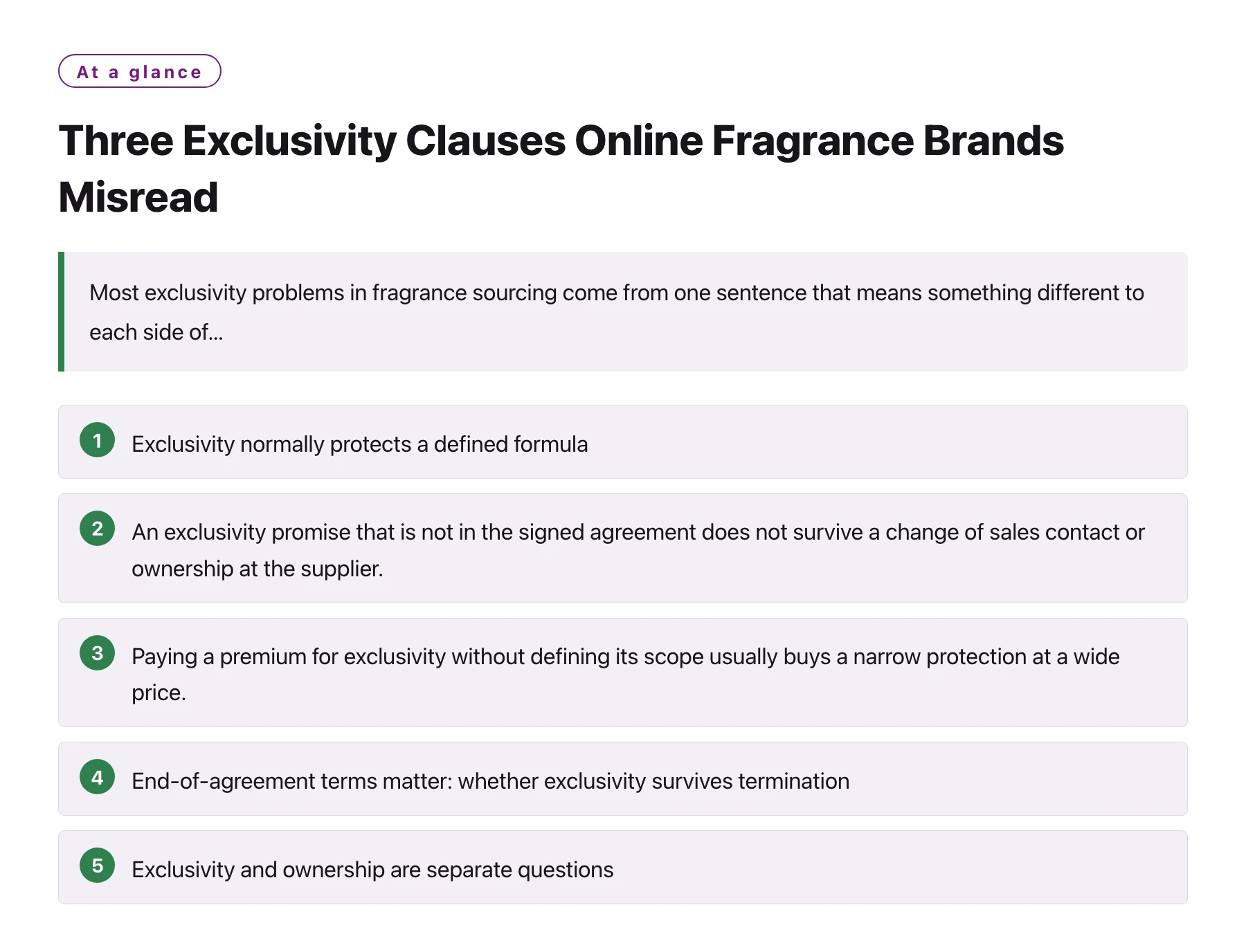
- Exclusivity normally protects a defined formula, market, channel or period, not a smell in general, because similar scents can be built from different materials.
- An exclusivity promise that is not in the signed agreement does not survive a change of sales contact or ownership at the supplier.
- Paying a premium for exclusivity without defining its scope usually buys a narrow protection at a wide price.
- End-of-agreement terms matter: whether exclusivity survives termination, who keeps the retained standard, and what happens to remaining stock.
- Exclusivity and ownership are separate questions, and a brand can have one without the other in either direction.
- A version register and a retained standard are what let a brand verify that the exclusivity it paid for is actually being respected.
Exclusivity sounds like a binary. In practice it is a set of boundaries, and the boundaries are what determine whether the protection is worth paying for. A brand that asks for exclusivity without stating which formula, which market, which channel and which period is asking for an undefined promise, and an undefined promise is difficult to enforce and easy to reinterpret.
The three misreadings below are drawn from the situations where online brands most often discover the gap: after a scent has become recognisable, after a supplier changes the account team, and at the end of a relationship when the brand wants to move production.
None of them requires an adversarial supplier to cause a problem. They happen because the clause was written in language both sides found reasonable at the time.
Misreading one: exclusivity protects a scent rather than a formula
A customer experiences a smell; a factory works from a formula. Exclusivity that names a formula protects the exact composition, including the materials and their proportions, and it does not prevent another brand from being sold a similar scent built with different materials. If the commercial value of the protection depends on the scent being distinctive in the market, the clause should say what it covers: the formula as recorded, the trade name, the accords developed during the brief, or a combination.
It also helps to be specific about the reference. A formula is identified by a version number, not by a product name, so the agreement should tie exclusivity to the approved version and to any later versions created for the same product. Otherwise a brand can hold exclusivity over version three while version four, created to solve a supply problem, sits outside it.
The practical wording asks two questions. What exactly is protected, and which later changes fall inside the protection. Answer both in the agreement and the ambiguity disappears.
Misreading two: the promise will survive the relationship it was made in
Exclusivity is often discussed early, agreed verbally, and never written into the signed documents. That works while the same people handle the account. It stops working when the contact changes, when the supplier is acquired, or when a new client asks for a similar project and nobody remembers the earlier conversation.
The remedy is unglamorous: a clause in the agreement, with a duration, a renewal mechanism and a stated scope. Also confirm which document controls if two documents disagree, because terms are sometimes split between a quotation, a development agreement and a purchase order.
Contracts are the instrument through which these arrangements are actually allocated, and guidance from WIPO on using intellectual property in commercial agreements exists precisely because conversations do not create enforceable positions [1]. The same discipline applies to confidentiality: if the brand does not want its project referenced publicly, that is a separate written term rather than an assumption.
Duration is not a formality
Exclusivity periods are often tied to the initial term of the supply agreement, which may be shorter than the commercial life of the product. When the supply agreement ends, the protection can lapse with it, leaving a recognisable scent unprotected at the moment the brand has the least leverage. Ask what happens to exclusivity on renewal, on expiry and on termination for convenience.
Misreading three: exclusivity and ownership are the same thing
They are separate. A brand can own the formula and still have no exclusivity, meaning the supplier cannot reuse the exact formula but the brand may not be the only party able to buy something similar. A brand can also have exclusivity without ownership, meaning nobody else receives the formula while the brand does not hold the rights to it.
Which combination suits an online brand depends on what it is protecting. If the risk is a competitor selling a nearly identical product, exclusivity language matters most. If the risk is losing access to the formula when changing suppliers, ownership and documentation transfer matter most. Most brands need a position on both, and the two are usually negotiated in the same conversation. A supplier that operates as a manufacturer that supports OEM and ODM will normally be able to say which mode a given project used, and that answer shows what the documentation package is likely to contain.
It is worth writing down how the two interact. A common structure is ownership assigned to the brand with a defined exclusivity period during which the supplier does not produce similar work for defined competitors. The important part is not the structure but that it is written and that both sides describe it the same way.
The three misreadings side by side
| Misreading | How it shows up later | Clarifying line to add |
|---|---|---|
| Exclusivity protects a scent rather than a formula | A similar product appears elsewhere and the clause does not apply to it | Name the protected formula by version, plus the trade name and any accords developed under the brief |
| The promise was never written down | A new account contact or a change of ownership resets the relationship to the default position | Put scope, duration and renewal in the signed agreement, and state which document controls |
| Ownership and exclusivity are treated as one term | The brand either cannot move production or cannot stop a similar product, depending on which half it actually needed | State both positions separately, and say how they interact during and after the supply agreement |
| Exclusivity is bought without a defined scope | A premium is paid for protection that does not cover the market or channel where the brand sells | Define territory, channel, format and period before discussing price |
| Termination is left vague | Exclusivity lapses, stock is stranded, or the retained standard stays with the factory | Agree what survives termination, who keeps the standard, and who may sell remaining stock |
Each row is a sentence the brand can propose. Suppliers rarely object to clarity in a term they have already agreed to in principle, and reviewing examples of fragrance projects with these questions in hand is a faster way to judge how a supplier documents its work than reading the same pages as marketing.
Making the position verifiable
A clause is only useful if the brand can tell whether it is being followed. Two records make that possible. The first is a version register, listing each approved formula version with its date and approval. The second is a retained standard, a sealed unit of the approved version held under known conditions.
With both in place, a reorder can be compared against the version that exclusivity covers, and a suspected infringement can be discussed in terms of a specific formula rather than a general impression. Without them, the brand is relying on the supplier's records alone, which is the weaker position even when the supplier is acting in good faith.
It is also worth knowing which of the brand's suppliers see the project as a development exercise rather than a catalogue order. The two behave differently when a formula has to be documented, protected and handed over, and the difference is visible in how they describe past work. Reviewing past work with the questions above in hand is more useful than reading it as marketing. Brands can compare that against Xuelei, which develops and manufactures under one roof, when deciding how much of the development chain they want to keep in one place.
Industry coverage of contract manufacturing and brand-owner relationships is a useful reminder that these terms are negotiated constantly rather than settled once [2], and trade reporting on product development discusses the same tension between speed to market and control over the formula [3]. Neither source resolves a specific contract, and both are a reminder that the clause, not the norm, decides the outcome.
If the supplier cannot answer what exclusivity covers without checking with someone else, ask for the answer in writing before the next order. A term that takes a week to explain is not a term that will be applied consistently.
Sources
- WIPO — World Intellectual Property Organization —— The UN agency for intellectual property; resources on industrial design and patent protection relevant to product and packaging design.
- Cosmetics Business —— A trade publication covering the beauty and cosmetics industry, including fragrance launches and regulatory developments.
- Cosmetics & Toiletries —— A technical magazine for cosmetic formulators, covering ingredients, formulation science and testing methods.
Frequently asked questions
Is exclusivity the same as owning the formula?
No. Ownership determines who holds the rights to the formula; exclusivity determines who else may be supplied with it. A brand can hold one without the other, and most agreements need a position on both.
How long should fragrance exclusivity last?
It depends on the product life and the leverage each side has. What matters is that the period is stated, that renewal is described, and that the brand knows what happens to exclusivity if the supply agreement ends early.
Does exclusivity stop a factory from making a similar scent for someone else?
Only if the clause covers similar formulas as well as the identical one. Formula-level exclusivity protects the recorded composition; broader language is needed to restrict comparable developments, and it usually costs more.
What should happen to exclusivity when I change manufacturers?
The agreement should state whether exclusivity survives termination, who retains the approved standard and documentation, and whether the original supplier may continue producing for others after the relationship ends.
How can I check that my exclusivity is being respected?
Keep a version register and a retained standard, and confirm which formula version the clause covers. Those records let a reorder be compared against the protected version rather than against an impression.
Working with Richard
Need a homepage that actually converts?
A 30-minute strategy call is the fastest way to find out whether your homepage, pricing page or product narrative is leaving revenue on the table — and what the rewrite would look like.